
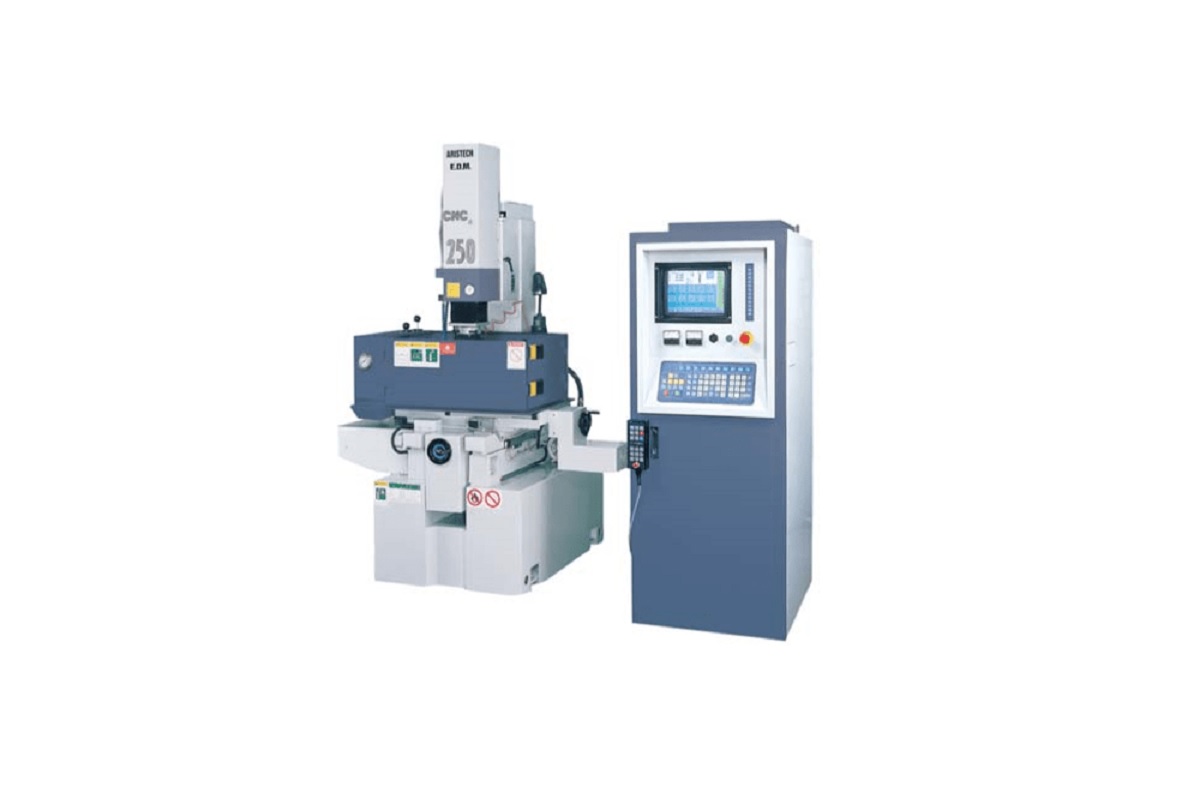
Wire cutting is also known as wire EDM, a technique based on EDM or Electrical Discharge Machining. Wire EDM makes it possible to machine parts with great precision in a fully automated process. What other advantages does it offer? And what is it used for?
What is wire cutting?
Machine tools that use wire cutting or EDM are machines that cut the profiles of a workpiece by means of electrical discharges. The parts machined with EDM technology can be metals and other conductive materials, concrete and stone structures, and even needles used in medicine. These parts can have highly complex geometries and therefore call for specialised machines capable of handling that complexity.
EDM works by means of electrical discharges. The workpiece is clamped on the machine table and the discharges spark across the gap between the workpiece and the wire. The wire is in continuous motion and acts as the machine's central axis. It is usually made of copper or brass and has the particular feature of exerting no real physical pressure on the part, which means that very thin and fragile workpieces can be machined.
Wire cutting is a thermodynamic and electrical process, and by no means a new one. EDM technology was in fact first used during the Second World War. The Russians were the first to develop a technique that used manual electrodes and electrical discharges to erode parts. This rudimentary technique would later evolve into modern EDM.
Benefits of EDM
Why is it a good idea to add wire cutting or EDM to a machining shop? What are the advantages of this technique? To begin with, it is highly effective and can machine any depth of cut. The best thing about this method is that it requires little effort and, depending on the type of machine, it may not even need an operator.
In addition, EDM machines make it easier to produce highly complex, precise parts that call for specific geometries and delicate cuts. The cutting speed of EDM machines is very high.
EDM or wire cutting can be applied to a wide range of machining processes on all kinds of parts. Narrow, tight surfaces can be machined, as the wire can reach difficult areas. Since EDM is a single-pass process, it is a cost-effective alternative in the long run and removes the need to process parts on conventional machines such as the lathe or the milling machine.
Wire cutting machines are easy to use and, depending on the model, they can be programmed to run with minimal intervention from an operator. This reduces production costs: not only is less labour needed, but manufacturing times are also shorter and, as a result, so are lead times.
As for the wire itself, it is universal and allows any part configuration to be produced. Before cutting, it is important to carry out heat treatments to prevent the part from distorting.
How wire cutting works
Wire cutting is based on a physical principle: the creation of an electric arc between the workpiece and an electrode. For the arc to form, the workpiece and electrode must be in a suitable environment, namely a dielectric medium. The aim is to remove particles from the surface of the workpiece until it reproduces the shape of the electrode.
What role does the wire play in this process? An EDM machine, which can fully machine a part in a single process, is fitted with a metal wire that cuts the part according to the previously programmed design. The wire works together with the electrical discharges. These discharges produce sparks between the workpiece and the wire, removing the excess material. That material must in turn be completely flushed from the surface of the part by a constant flow of dielectric fluid.
What is wire cutting used for?
EDM is widely used in toolmaking and tooling and mould making because of its precision and because very hard materials can be machined. The flexibility of the process makes it possible to machine the most complex and difficult shapes, which could not be produced with any other technique or would take a long time and, consequently, result in a high machining cost.
Besides tools and moulds, it can be used to manufacture gauges, stamping tools, disc cams, punches, dies and blanking dies, as well as electrodes.