
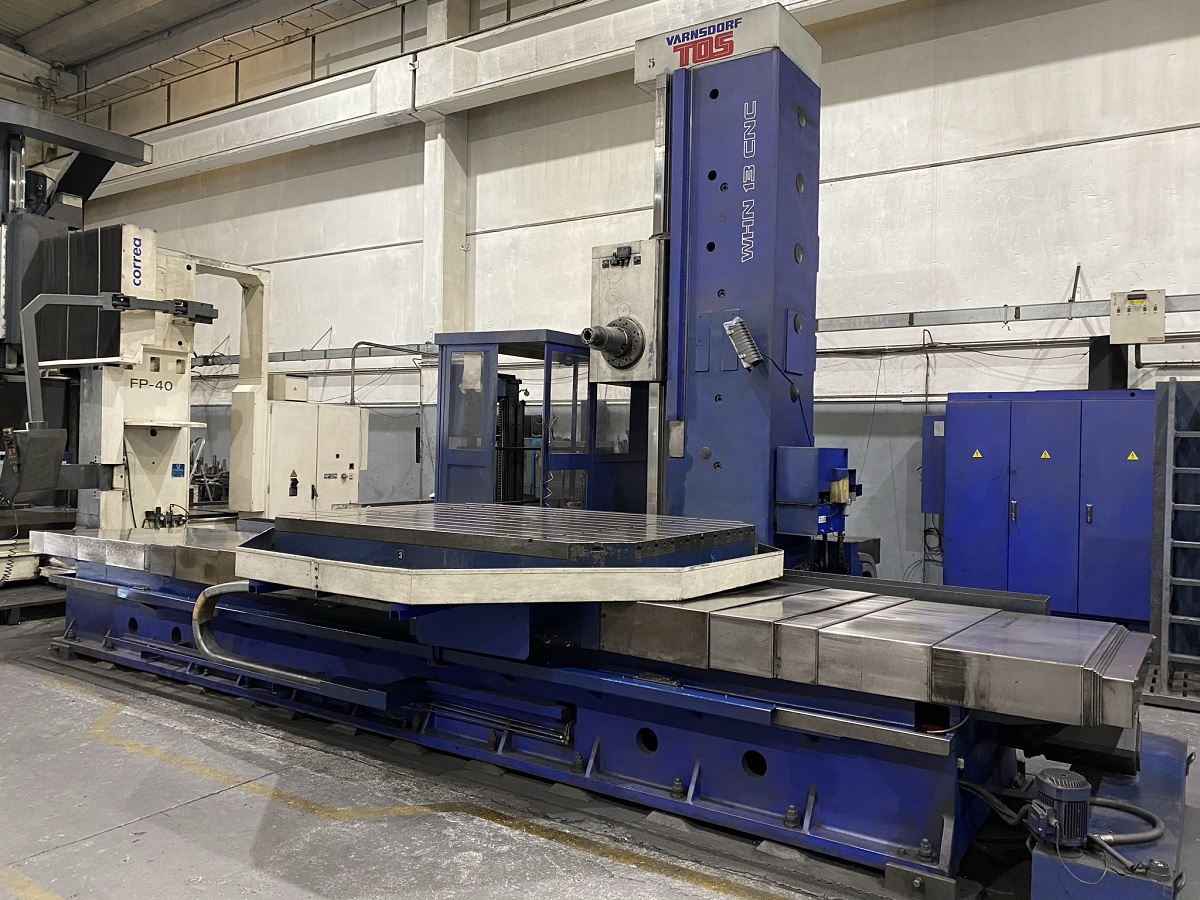
The boring mill, also known as a boring machine, is a conventional machine tool used to machine prismatic parts to close tolerances with a high-quality finish. How is a boring mill built? What are its main parts? How does it work?
How a boring mill works
To machine prismatic parts, the workpiece is placed on the worktable while the boring tool rotates. The tool is held in the machine's tool spindle, which generates the speed required for the job. This speed varies according to the type of material to be machined and the axial feed into the part. One characteristic of the boring mill is that the machining processes carried out on it are expensive. That is why it is important to choose the right boring tool to keep machining time to a minimum while achieving precise, high-quality results.
What is boring? And what is a boring mill? Boring is a machining operation carried out on certain parts to achieve greater precision and lower surface roughness; it is usually performed on parts with cylindrical or tapered holes. This operation is also used to cut internal threads.
It follows that the machine capable of carrying out boring work is the boring mill or boring machine. These are highly specialised machines that must work to very tight tolerances and deliver precise machining quality. Boring mills are also able to work in very confined areas.
How to choose a boring mill
When choosing a boring mill, certain parameters must be taken into account, such as the constraints of the workpiece and its design. The size, tolerance and finish required must also be considered. It is equally important to know whether the boring mill can handle the workpiece materials: this means looking at their hardness, condition, strength, whether they are cast iron, and so on. But it is not only the part that must be analysed; so must the boring operations to be performed on the machine tool: grooving, roughing, finishing, internal and external work.
It is advisable to know the characteristics of each boring operation to be performed and the related parameters, such as cutting speed, power or the type of machine drive. You should also consider whether you want automatic machining, whether the machine requires coolant and in what quantities and, of course, the characteristics of the boring tool.
Types
In addition to the conditions described above, choosing a boring mill depends on the type of machine tool you are looking for. A simple boring operation can be carried out on lathes, so if you do not do much of this kind of work, a lathe may well be enough. Otherwise, you can opt for one of the types of boring mills available in the industry.
- Jig borers. Jig borers are designed for locating and boring holes in jigs, gauges, dies and parts that require very high machining accuracy. They resemble vertical milling machines.
- Vertical boring mill. This machine tool is characterised by rotating on a horizontal table.
- Horizontal boring mill. Unlike vertical machines, horizontal boring mills operate in a stationary manner. They have a horizontal spindle held at one end and another rotating spindle that works in the opposite direction.
Parts of a boring mill
Although there are different types of boring mills, as we have seen, these machines share common components whose position and layout vary depending on the type of machine tool used. The common components of a boring mill are the table, the frame, the bed, the spindle, the head and the carriage.
One of the most important components is the bed, which supports the machine and must be rigid and stable, as it has to dampen the movements and vibrations generated during machining. The bed rests on the floor, and attached to it is the frame, which carries the machine tool's head, where the spindle is housed.
The machine is also fitted with a vertical column, along which the motorised head travels. The boring mill also has a work-holding table, a rotary surface on which the parts to be machined are placed. Connected to the work-holding table is the longitudinal carriage. As well as being attached to the table, it runs on rails along the bed and allows the workpiece to move horizontally.
The boring mill also has head guideways. The head can move vertically along the frame rails, driven by a screw. Finally, the machine has a main spindle and a further spindle that transmits the table feed motions.